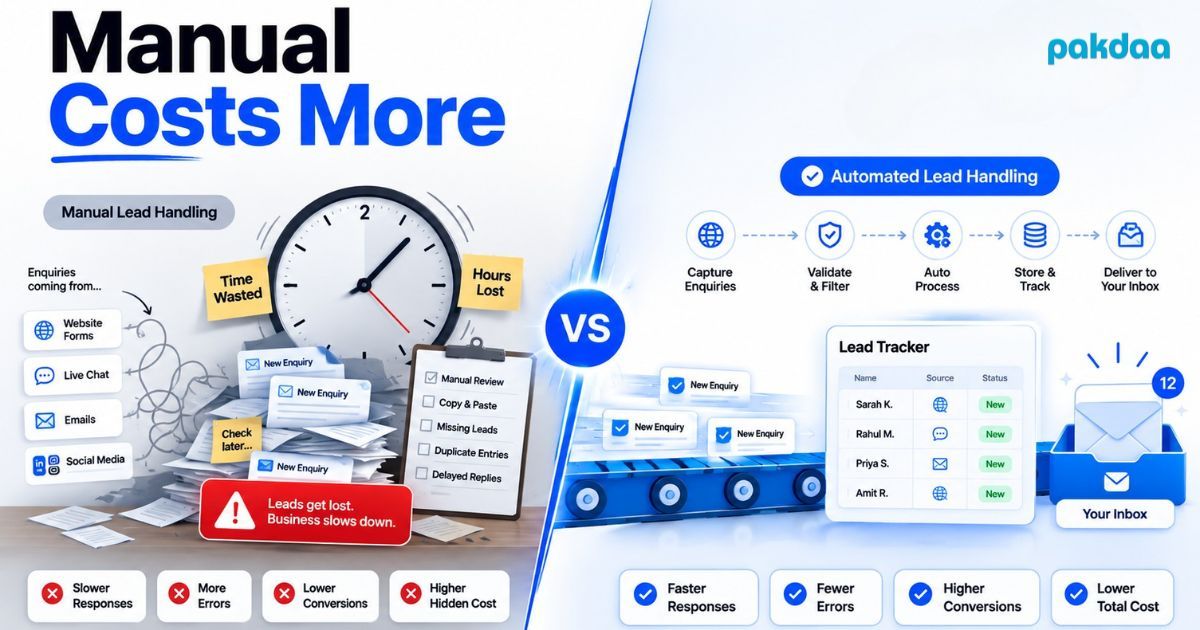
Managing contact forms manually feels free. Nobody sends you an invoice for it. An enquiry arrives, someone copies the details somewhere, replies when they get to it, and follows up if they remember. No line item, no cost. Right?
Wrong. It is one of the most expensive habits a small business has, precisely because the bill is hidden. The hours add up, the errors cost deals, and the slow replies lose leads you already paid to get. You just never see the total, because it is paid in scattered minutes and quiet misses.
Here is the real cost of doing it by hand, a rough way to put a number on it, and what changes when you automate the boring parts.
Why the cost stays invisible
Manual work hides its price because it never shows up as a single expense. It is spread across busy afternoons, forgotten follow-ups, and a lead that went cold three weeks ago that nobody connected to the delay.
If you had to write a cheque each month for "time lost to copying leads by hand", you would automate it tomorrow. The only reason you have not is that the cost is invisible, not that it is small.
The five hidden costs of manual handling
Break it down and the same five costs show up in almost every business.
1. Time you could spend selling
Every enquiry copied by hand, every reply typed from scratch, every follow-up chased manually is time not spent on actual sales work. Do it dozens of times a week and it becomes a part-time job nobody was hired for.
2. Speed you cannot hit by hand
Manual routing almost guarantees you miss the window that matters. Leads contacted within five minutes are far more likely to qualify than those reached after 30, per research widely cited from Harvard Business Review. If a human has to notice, copy, and act before anyone replies, five minutes is long gone.
3. Human error
People miss things. A lead gets skimmed and forgotten, a phone number is mistyped, an enquiry sits in a tab that got closed. Every manual step is a fresh chance to lose or corrupt a lead, and you rarely find out you lost one.
4. No visibility
Handled by hand, your leads live in someone's head and inbox. You cannot see how many came in, which are still open, or where deals are stalling. You are running the most important part of your business blind. That is exactly the gap a simple system closes, as we cover in our guide to tracking leads without a CRM.
5. It does not scale
Manual handling works at five leads a week and breaks at fifty. The busier you get, the more leads slip, which means your worst lead loss happens exactly when business is best. That is the cruelest part of the hidden cost.
Here is how each manual step maps to its cost and its fix.
Putting a number on it
You do not need exact figures to see the problem. A rough estimate is enough to make the point.
Say handling each lead by hand, logging, routing, chasing, takes ten minutes, and you get forty enquiries a week. That is over six hours a week, more than 300 hours a year, on work a machine could do instantly. Now add the deals lost to slow replies and errors, and the real total climbs well past the time alone.
Even at a modest hourly value, 348 hours a year is a serious number. And it is the smaller half of the cost, because the leads lost to slow, error-prone handling usually outweigh the wasted time.
What automation actually replaces
Automating lead handling does not mean replacing your team or your judgment. It means removing the mindless middle steps: the enquiry is captured and stored the instant it arrives, an alert fires so someone can reply fast, and every lead is logged and tracked without anyone copying a thing. Your people still do the human part, the actual conversation and the sale. This is the same "capture everything, miss nothing" system we describe in our guide to never missing a customer enquiry.
How to move from manual to automated
You can do this in stages. Here is the order that gives the fastest payback.
Step 1: Map your current manual steps
Write down every manual action a lead triggers today, from copying details to following up. You cannot automate what you have not named.
Step 2: Auto-capture and store every submission
Connect your form so each enquiry is saved automatically to a sheet or database the moment it arrives. This kills the copying and the typos in one move.
Step 3: Auto-route and alert
Send every new lead to a live channel your team watches, instantly, so fast replies stop depending on someone noticing.
Step 4: Auto-log to a tracker
Have each lead land in your tracking system with a status, so visibility is automatic instead of a manual chore.
Step 5: Keep a human on the reply
Automate the plumbing, not the relationship. Let people handle the actual conversation, where judgment and warmth win the deal.
Step 6: Review and refine
Check what is flowing smoothly and what still needs a human nudge, and tighten the system over time.
The bottom line
Managing contact forms manually is not free. It is paid in wasted hours, slow replies, quiet errors, and leads that vanish under load, a bill you never see but always pay. Automate the boring middle, capture, store, alert, and log, and you get those hours back and stop losing deals to delay. Your team keeps the human parts and drops the busywork. If you want that flow built for your business, that is exactly what our team does.
Still handling every enquiry by hand?
We will automate the busywork, capture, storage, alerts, and tracking, so your team stops copying leads and starts closing them. Free to map out.
Book a free automation call