Every week the update says "on track." Then, three days before the deadline, it suddenly says "we need two more weeks."
The project didn't go wrong in those three days. It was slipping for a month. The signals were there. Nobody was looking for them, or the people who saw them didn't say anything.
Project early warning signs are the small, visible clues that show up weeks before a deadline is missed. Learn to read them and you can fix a project while it's still cheap to fix. Miss them and you find out when the client does.
Why Project Early Warning Signs Get Missed
Here's the uncomfortable research finding. In a study of complex projects presented at PMI's Global Congress, Klakegg, Williams, Walker and colleagues concluded that project professionals are "not very good at detecting early warning signs and even less good at acting on them" (PMI research on early warning signs). Several people they interviewed said the signs were obvious in hindsight. They just weren't acted on.
The same study pointed to why: optimism, time pressure, political pressure and the belief that someone else's review would catch the problem.
That matches what our team sees in growing businesses. People don't hide problems on purpose. They hope to fix them quietly before anyone notices. Sometimes they do. Often they don't.
What is a "watermelon" project?
Green on the outside, red on the inside. The status report says everything is fine, but the actual work is behind. It happens when status is based on opinion ("I think we're on track") instead of evidence ("8 of 12 tasks are done and nothing is blocked").
Why don't teams act on warning signs?
Because raising a flag feels like admitting failure, and there's always hope that next week will be better. If your culture punishes bad news, people will keep it to themselves until it can't be hidden anymore.
8 Project Early Warning Signs to Watch
Some signals come from data. Others come from how people behave. You need both.
Hard signals: what the data tells you
1. Tasks are getting old. The Kanban Guide calls this work item age: how long a task has been in progress since it started. Reviewing aging items regularly helps you "spot early signs of delays, bottlenecks, or potential flow issues" (ProKanban on work item age). A task that usually takes three days and has been open for nine is telling you something.
2. The "waiting" pile keeps growing. More tasks waiting on approvals, clients or other teams each week means work is piling up somewhere. Growing queues show up long before missed dates.
3. Approvals are getting slower. If sign-offs used to take a day and now take a week, your decision-makers are overloaded. Everything behind them will slow down too.
4. "Almost done" two weeks in a row. When the same task is 90% done in two consecutive reviews, the last 10% is hiding a problem. Ask what's actually left.
5. Scope keeps shifting. New requests getting added without the deadline moving is one of the clearest signals there is. Every "small change" quietly eats your buffer.
Soft signals: what people tell you
6. Answers get vague. "Should be fine." "Working on it." "Almost there." When updates lose specifics, the person giving them often isn't sure either.
7. Key people are stretched or pulled away. In a study of 55 IT project managers, Kappelman, McKeeman and Zhang listed overscheduled experts and resources diverted to other projects among the dominant early warning signs (Early Warning Signs of IT Project Failure). If your best person is suddenly on three other things, this project will feel it.
8. The owner or sponsor goes quiet. The same study ranked lack of top management support as the most important warning sign of all. If the person who should be making decisions stops showing up to reviews, decisions stop getting made.
What This Looks Like in a Real Business
Here's a pattern our team sees often. Picture a 45-person manufacturing company in Chennai rolling out a new inventory system. Go-live is in eight weeks.
Week three, the weekly update says "on track." But the data migration task has been open for 12 days when it should take five. Two tasks are waiting on the plant head's approval, and he's travelling. The vendor added "a few extra reports" to scope. The IT lead is also handling a server issue.
No single thing looks serious. Together, they're a clear signal.
In the version of this story that ends badly, nobody connects the dots until week seven. In the version that ends well, the weekly review catches the aging migration task, a deputy gets approval rights, the extra reports move to phase two and the IT lead gets backup. Go-live slips by three days instead of a month.
Same project. Same problems. The difference is spotting them early.
How to Build an Early Warning System for Your Projects
You don't need complex software to start. You need a few habits and the right data.
Step 1: Record when each task starts
You can't measure age without a start date. Make sure every task records when work began, not just when it's due.
Step 2: Know what "normal" looks like
For common task types, note how long they usually take. A design round, a client approval, a data import. Once you know normal, anything well beyond it stands out.
Step 3: Add "waiting" and "blocked" statuses
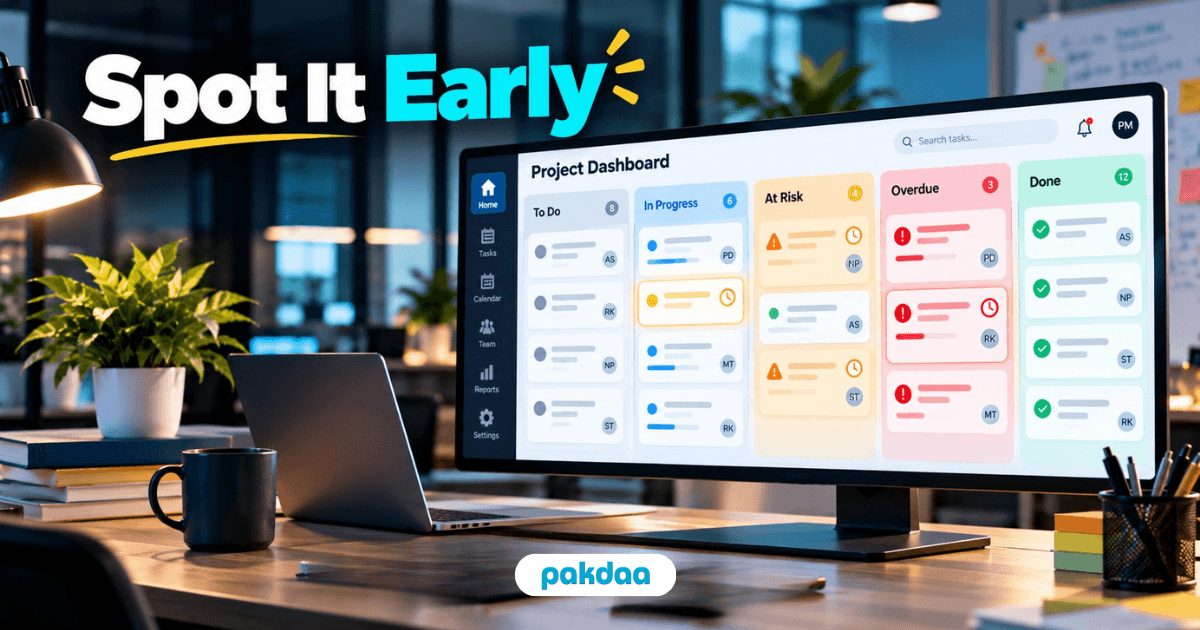
If a task is stuck, it should look stuck. A separate status for waiting on someone else makes queues visible instead of hiding them inside "in progress."
Step 4: Run a weekly health check
Fifteen minutes. Look at your oldest open tasks, everything waiting or blocked, and any scope added this week. Use the same questions every time so trends become obvious.
Step 5: Ask for evidence, not opinions
Replace "are we on track?" with "what's done, what's left and what's blocking you?" Specific questions get specific answers. Vague questions get "should be fine."
Step 6: Act within 48 hours on a red flag
A warning sign only helps if someone does something. Agree that any red flag gets an owner and an action within two days: reassign, unblock, cut scope or move the date early.
Step 7: Get an outside view once a month
The PMI research found an outside perspective helps catch what insiders miss. Once a month, have someone not on the project ask the hard questions.
How often should you check project health?
Weekly for most projects. For short or high-risk projects, a quick check twice a week is worth it. The key is consistency: the same questions, the same time, every week.
Let the System Raise the Flag
Manual health checks work. But they depend on someone remembering to look, and on data that's actually up to date.
That's where our team at Nipralo helps. We build custom project dashboards that flag warning signs automatically: tasks running past their normal time, growing waiting queues, slow approvals and scope added mid-project. Instead of finding out in a meeting, you get an alert while there's still time to act. See what we build on our services page.
Spotting the signs is step one. If you want to understand what causes them, read our breakdown of stuck projects and hidden bottlenecks. And if deadlines break because of how they're planned, our post on whether to blame your team or your plan covers that side.
The Bottom Line on Project Early Warning Signs
Projects rarely fail overnight. They slip quietly, one aging task, one slow approval and one extra request at a time. The signs are almost always there.
Watch the hard signals: aging tasks, growing queues, slow approvals, repeated "almost done" and shifting scope. Listen for the soft ones: vague answers, stretched people and a quiet sponsor. Then check weekly, ask for evidence and act fast.
Project early warning signs are only useful if you look for them before the deadline does the looking for you.
Want a second pair of eyes on a project that feels like it's slipping? Book a free 20-min call with our team. We'll walk through it with you and show you which signals to fix first.