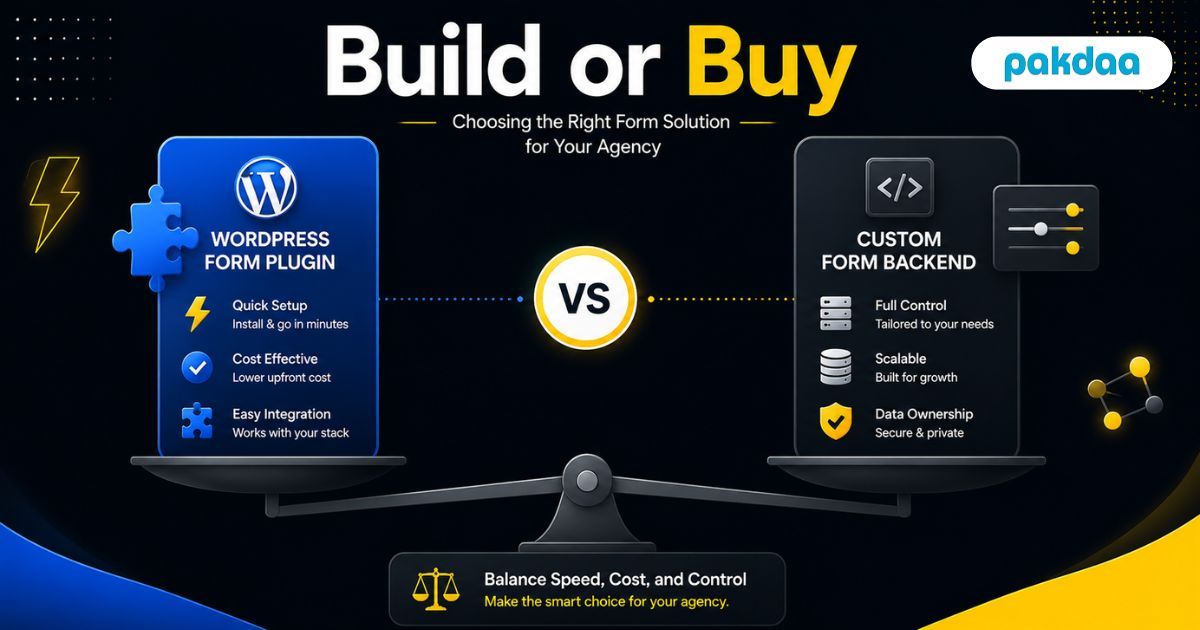
Every agency makes this call on nearly every project: do we just drop in a WordPress form plugin, or build a custom form backend? And plenty of agencies pick one out of habit rather than thinking, which is how you end up over-engineering a brochure site or under-building a lead machine.
So here is an honest comparison of a custom form backend vs a WordPress plugin, for agencies specifically. Not a pitch for one side, because neither wins every time. The goal is a clear framework for when to reach for each.
Let us start by being fair to both.
First, the honest framing
WordPress plugins are the default for good reasons, and often they are the right answer. A custom backend is more powerful, and often overkill. The real question is not which is "better" in the abstract, but which fits this client, this site, and your workflow across all your clients.
Keep that in mind as we go, because the answer genuinely flips depending on context.
The case for WordPress form plugins
Plugins earned their popularity. WordPress powers a large share of the web, commonly cited at over 40% of all sites, per WordPress ecosystem figures, so the tooling is mature and everywhere.
For an agency, plugins are fast to deploy, cheap or free, and familiar to any WordPress developer. They come with a visual builder, built-in validation, and a huge ecosystem of add-ons. For a small brochure site, a low-volume contact form, or a one-off project, a good plugin is not a compromise. It is the sensible, economical choice, and building custom would be a waste of the client's money.
The case for a custom form backend
A custom backend trades speed for control. You decide exactly how submissions are validated, stored, routed, and monitored, and it works the same way on every site regardless of the platform.
At scale, that consistency matters. There are no plugin updates to break things, no per-site quirks, and you can send every client's leads into one central store and dashboard, which we covered in our guide to managing many client forms from one dashboard. It also plugs cleanly into automation, which we covered in our guide to automating lead management with form integration. The tradeoff is real: more upfront effort and cost.
Head to head
Here is how they compare on what actually matters to an agency.
Where plugins genuinely win
Be honest with yourself and the client. A plugin is the right choice when the site is small, the lead volume is modest, the budget is tight, or the project is a one-off with no ongoing management. In those cases the speed and low cost of a plugin beat the control of a custom build the client does not need. Reaching for a custom backend here is over-engineering.
Where a custom backend genuinely wins
A custom approach earns its cost when you are running many client sites, when reliability is business-critical, or when you want every client's leads flowing into one place with automation and monitoring on top. It also wins when you are building a product-like service, such as a client lead portal, where plugin sprawl would be a nightmare to manage.
If your agency lives or dies on captured leads across a portfolio of sites, the consistency pays for itself.
The hidden cost nobody counts
Here is the part that quietly decides it for many agencies: maintenance. A plugin is cheap to install and not cheap to maintain across fifty sites.
Every plugin needs updates. Updates sometimes break forms. Plugins get abandoned, develop security holes, or conflict with other plugins. On one site that is a minor chore. Across a whole client portfolio, it is a recurring tax on your team's time and a recurring risk to your reputation when a form breaks silently. That ongoing cost rarely shows up in the original quote, but it is real, and it grows with every client you add.
How to decide
Work through these and the answer usually becomes clear for the project in front of you.
Step 1: Assess the site and volume
For a small, low-volume, low-maintenance site, lean plugin. For a lead-critical or high-volume site, lean custom.
Step 2: Count the clients
One or a few sites favour plugins. A large, growing portfolio favours a consistent custom approach you maintain centrally.
Step 3: Weigh maintenance honestly
Add the ongoing update and breakage cost across all sites, not just the setup cost. Plugins look cheaper until you count this.
Step 4: Check your data needs
If you need every client's leads centralized, automated, or shown in a portal, a custom backend or a shared endpoint is worth it. If each site's leads can live alone, a plugin is fine.
A middle path worth considering
It does not have to be all or nothing. A common hybrid keeps a familiar plugin for the front-end form on each site, but points its submissions at one shared store or endpoint you control. You get the speed and familiarity of the plugin with the central, reliable data of a custom backend. That store-it-centrally principle is covered in our guide to storing form submissions instead of emailing them.
The bottom line
There is no universal winner. WordPress form plugins are fast, cheap, and the right call for small or one-off sites, and building custom for those is a waste. A custom form backend wins when you run many clients, need reliability and central data, or are building a lead service where plugin sprawl would sink you. Count the ongoing maintenance, not just the setup, and consider the hybrid path. If you decide a custom or centralized approach fits your agency, that is exactly what our team builds.
Weighing build vs buy for your client forms?
We will look at your client mix, volume, and maintenance load, then recommend the right approach, plugin, custom, or hybrid, and build it if it fits. No hard sell.
Book a free build-vs-buy call