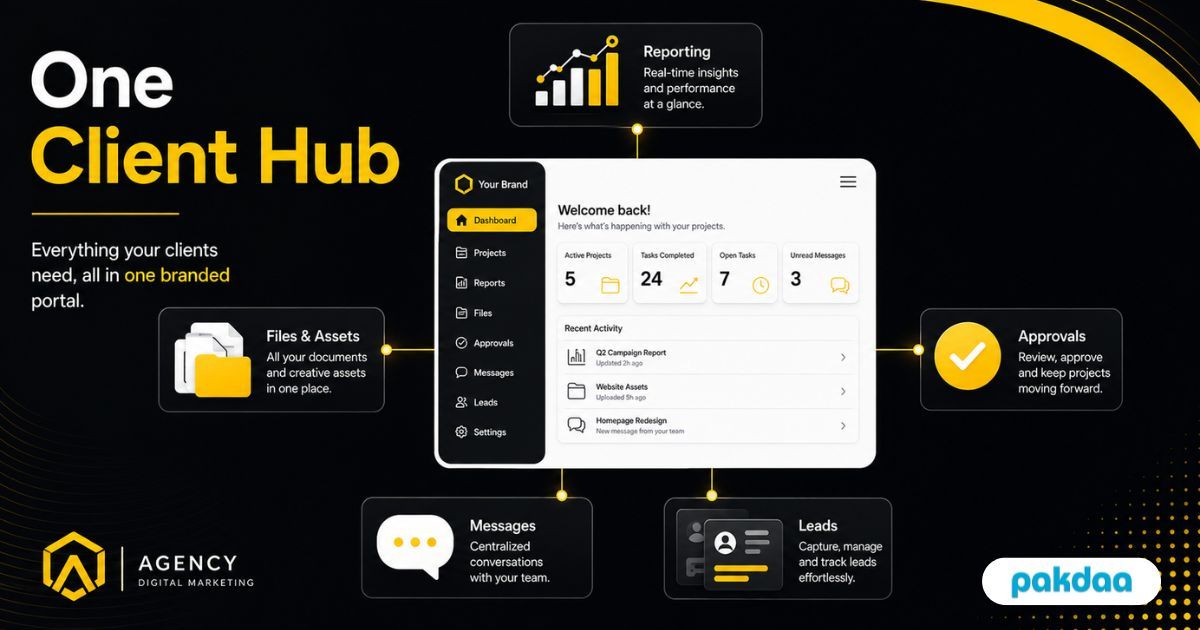
Think about how a client currently experiences your agency. Reports arrive by email. Assets live in a shared drive somewhere. Approvals happen in chat. Leads sit in a spreadsheet. Invoices come from another tool entirely. Five channels, and every one is a place something gets lost and a reason the client feels out of the loop.
A private client portal fixes that by pulling it all into one branded place the client logs into. And the benefits of a client portal for marketing agencies go well beyond tidiness. Done right, it drives trust, retention, efficiency, and a more professional client experience, the things that keep accounts and justify higher fees.
Here is what a portal actually does for an agency, where the value really comes from, and an honest note on when it is not worth building.
The scattered-touchpoints problem
Fragmentation is the quiet tax on every agency relationship.
When your work is spread across email, drives, and chat, the client never has a single, current view of what you are doing for them. They ask for last month's report again. They cannot find the asset you sent. They wonder whether their leads are being handled. Each small friction chips at their confidence, and confidence is what renewals are made of.
What a marketing agency client portal is
It is one secure, branded hub where a client sees and does everything related to your work for them.
In one place: live reporting, deliverables and assets, approvals and feedback, messages, and their leads. It carries your agency's branding, and access control means each client sees only their own space. Instead of chasing five channels, the client has one login, and so does your team.
The benefits, and where the value comes from
Six benefits, and they build on each other.
1. Everything in one place
The most immediate benefit is simple: less gets lost and less time is wasted hunting. One hub for reports, assets, approvals, and leads removes the friction of five scattered channels for both sides.
2. Trust through transparency
When a client can see the work happening, live reporting, leads arriving, deliverables landing, they stop wondering whether they are getting value. Visible work is trusted work, and a portal makes that visibility automatic instead of something you have to keep proving.
3. Stronger retention
This is where the money is. Keeping a client costs a fraction of winning a new one, with widely cited research putting acquisition at several times the cost of retention. A portal a client logs into regularly keeps your value front of mind and makes leaving feel like a loss. It quietly protects your recurring revenue.
4. Real efficiency
Every "can you resend the report" and "did that lead come through" email is friction for your team. A portal answers those before they are asked, freeing your people from being a human lookup service and giving them hours back each week.
5. A premium, professional experience
Most agencies deliver via email and drives, so a branded portal instantly sets you apart. It makes your agency feel like a product, not a freelancer, which supports higher fees and a stronger pitch to new clients.
6. Consolidated lead visibility
Leads are one of the highest-value things to put in a portal, because they are the proof of your work. Giving each client real-time visibility of their own leads is powerful enough that we dedicated a full guide to it: why your agency needs a client lead portal.
What a good agency portal includes
Not every portal delivers these benefits. A useful one covers the areas that actually cause friction today.
You do not need every feature on day one. Start with whatever channel causes the most friction now, usually reporting or leads, and expand from there.
When a portal is not worth it
To be straight with you: a portal is not always the right call. If you are a very small agency with one or two low-touch clients, the setup and upkeep may cost more than the friction it removes. If clients will not actually log in, a portal nobody uses is worse than no portal, it is wasted effort that still needs maintaining.
Build one when fragmentation is genuinely costing you time or trust, or when a polished client experience would help you win and hold bigger accounts. If neither is true yet, email and a shared drive are fine for now.
How to roll one out
If it does fit, here is a sensible order.
Step 1: Consolidate the highest-friction channel first
Pick the one thing that causes the most back-and-forth today, often reporting or leads, and move that into the portal first. Prove the value before expanding.
Step 2: White-label it
Brand the portal as your agency. It should feel like your product, with your logo, colours, and domain.
Step 3: Set per-client access
Add access control so each client only ever sees their own space. This is essential for trust and privacy.
Step 4: Add reporting and leads
Bring live reporting and lead visibility in early, since these are the clearest proof of your value. The lead piece builds on our client lead portal guide.
Step 5: Make it part of onboarding
Give every new client portal access as standard, so it becomes how you work, not a special request. This fits the standardization in our agency form playbook.
Step 6: Get clients actually using it
Walk clients through it, point them there for reports and leads, and stop sending those by email. Adoption is what turns a portal into a retention tool.
The bottom line
The benefits of a client portal for marketing agencies come down to one idea: consolidation. Put reporting, assets, approvals, communication, and leads in one branded hub, and you build trust, protect retention, save your team hours, and deliver an experience that stands apart. Just build it because fragmentation is actually costing you, not because it sounds nice. If a portal fits your agency, that is exactly what our team builds.
Client work scattered across five channels?
We will build a branded client portal that brings reporting, assets, approvals, and leads into one place, so clients stay in the loop and stay longer. Free to scope.
Book a free portal consult