Ask an agency how a client's lead capture is going and you get confident answers. Ask the client, and you often get a shrug. They cannot see the leads. They just trust that you are handling it, and trust with no proof has a short shelf life.
That gap is where clients quietly start to doubt your value. A private client portal closes it. Give each client a secure, white-label login where they watch their own form submissions and leads arrive in real time, and the black box becomes a glass box. Suddenly your work is visible, and visible work is work clients keep paying for.
This is why a client portal is less a feature and more a retention asset. Here is what it is, why it matters, and how to add one.
The black box problem
Right now, for most agencies, lead capture is invisible to the people paying for it.
The leads land in your systems, you act on them or forward them, and the client sees only whatever you choose to report, usually a number in a monthly email. When results dip, they have no window into what is actually happening, so they assume the worst. Invisible value is the easiest value to cancel.
What a private client portal actually is
It is a secure, branded space where each client sees only their own data.
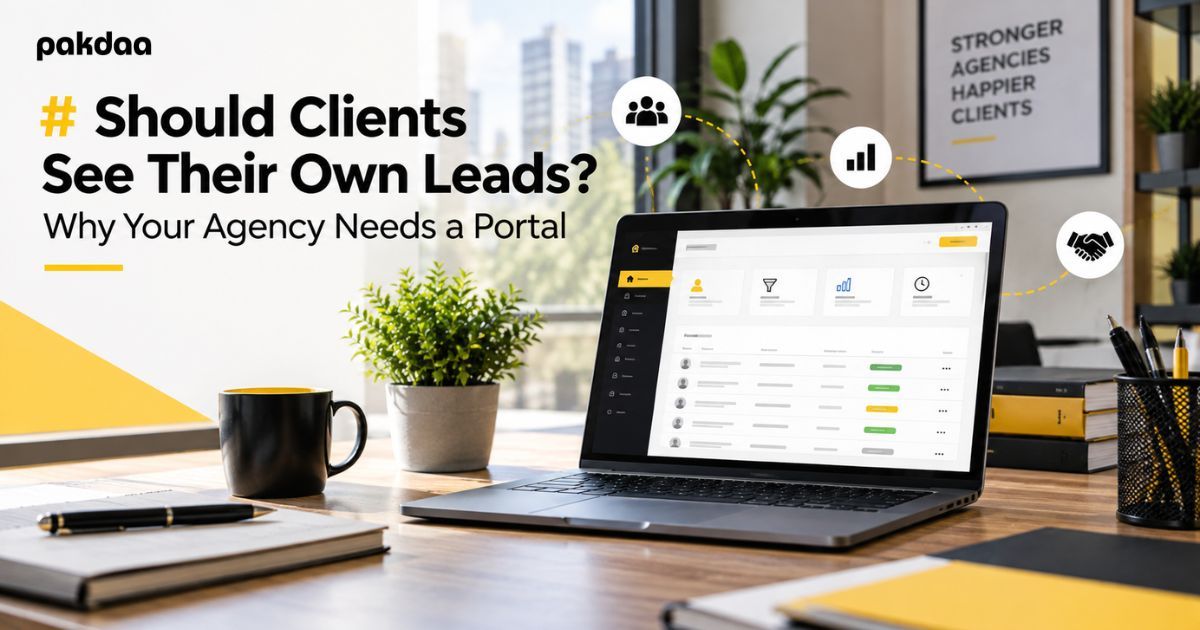
They log in, and there are their form submissions and leads, updating live, filterable, exportable, with statuses they can follow. It carries your agency's branding, not a third party's, and access control means each client sees their leads and nobody else's. The engine behind it is the same central store and dashboard we described in our guide to managing many client forms from one dashboard. The portal is simply the client-facing window onto it.
Why every agency needs one
Five reasons, and they compound.
1. Trust through transparency
When a client can watch leads arrive themselves, they stop wondering whether you are doing your job. The proof is on their screen. Transparency is the fastest way to build trust, and a portal makes it automatic.
2. Retention
Keeping a client costs a fraction of winning a new one, with widely cited figures putting acquisition at several times the cost of retention. A portal is stickiness: a client logging in weekly to see their leads is a client who feels the value and is far less likely to leave. It quietly protects your recurring revenue.
3. Differentiation
Most agencies pitch the same services in the same words. Very few say "and you will have your own portal to see every lead we capture, live". That single line separates you from competitors and justifies a premium.
4. Fewer status-check emails
Every "did you get my enquiry from Tuesday?" email is friction for both sides. A portal answers those questions before they are asked, freeing your team from being a human lookup service.
5. Faster action on leads
When clients see leads land in real time, they act faster, and speed wins deals. Leads engaged within five minutes qualify far better than those reached after 30, per research widely cited from Harvard Business Review. A portal turns your client into a fast-acting partner instead of a bottleneck.
What a good client portal includes
Not every portal earns trust. A useful one covers these.
Miss real-time updates or white-label branding and the portal stops feeling like proof and starts feeling like a stale report. The point is a living window, branded as yours.
The engine behind the portal
A portal is not a separate system you build from scratch per client. It sits on top of the central store where all your client submissions already live. That is what makes it practical at scale: one store, one dashboard for you, and a scoped, branded view for each client.
It also productizes the manual reporting step from our agency form playbook. Instead of assembling a lead summary by hand each month, the portal shows it continuously, on demand, with zero extra effort from your team.
How to add a client portal
You can roll this out in stages.
Step 1: Centralize submissions first
Get every client's form submissions flowing into one central store. The portal needs a single source to read from.
Step 2: Scope data per client
Add access control so each client login only ever sees its own leads. This is non-negotiable for security and trust.
Step 3: White-label it
Brand the portal as your agency, your logo, your colours, your domain. It should feel like your product, not a bolted-on tool.
Step 4: Show leads in real time with status
Surface submissions live, with statuses clients can follow, so the portal is a working view, not a static export.
Step 5: Give secure logins
Set up proper authentication so lead data stays protected and each client trusts the space.
Step 6: Make it part of onboarding
Include portal access in how you onboard every new client, so it becomes a standard part of the service, not a special request.
The bottom line
If your clients cannot see the leads you capture for them, you are asking them to pay for something they have to take on faith, and faith runs out. A private client portal turns invisible work into visible proof: real-time leads, white-label, each client seeing only their own. It builds trust, protects retention, sets your pitch apart, and cuts the busywork. Build it on the store your leads already flow into, and it becomes your agency's quiet competitive edge. If you want one built for your agency, that is exactly what our team does.
Want to give your clients their own lead portal?
We will build a secure, white-label client portal on top of your lead capture, so every client sees their own submissions in real time, branded as your agency. Free to scope.
Book a free portal consult